Ranking in Houston’s Map Pack Across a 10,000-Square-Mile Metro
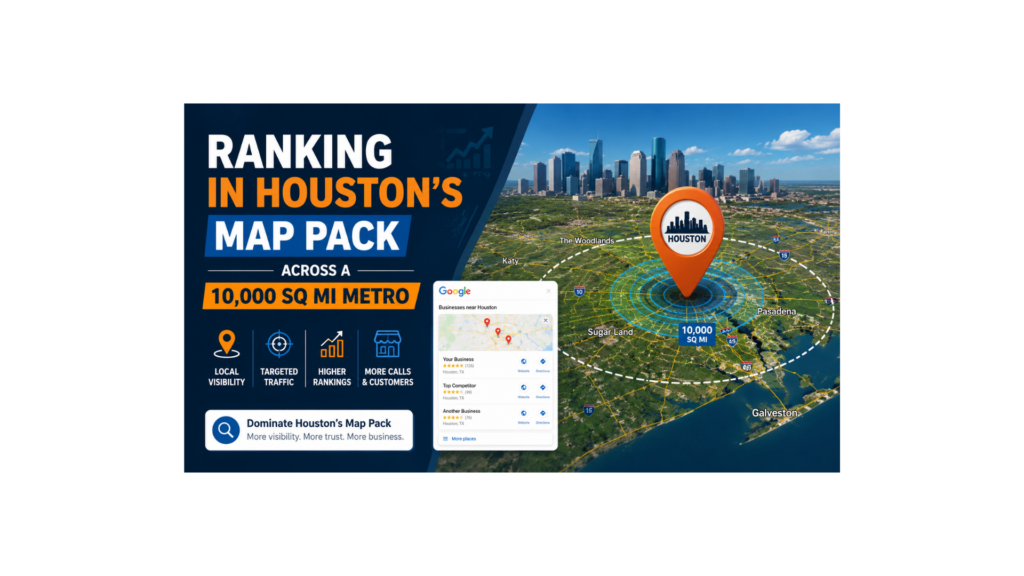
Greater Houston covers roughly 10,000 square miles across ten counties with about 7.8 million residents, which means Google Map Pack results change substantially between Katy, Sugar Land, The Woodlands and Pearland. Ranking across it requires one fully optimised Google Business Profile, genuinely distinct location pages, consistent citations, and reviews that mention specific suburbs. It does not require — and will be punished for — seven near-identical pages with the city name swapped.
If you’ve ever had a customer in Katy tell you they couldn’t find you on Google while you’re sitting at number two in Cypress, this post is about why that happens and what to do about it.
Quick answer: why Houston is harder than most cities for local SEO
Most local SEO advice is written for cities where “the city” is one market. Houston isn’t. The city proper is about 665 square miles — already larger than most American cities — and the metro it anchors is roughly fifteen times that.
Three consequences follow:
- Proximity dominates. Google weights physical distance heavily in local results. A business in northwest Houston is 40+ miles from Pearland. In Map Pack terms that’s a different city.
- Each sub-market is its own competitive set. Your Katy competitors are not your Cypress competitors. Difficulty varies enormously between them.
- One page cannot serve them all. A single “Houston” service page will rank near your office and fade with distance, no matter how good it is.
How proximity works in the Map Pack
Google’s local results balance three things: relevance, distance and prominence. You can influence relevance and prominence. Distance you cannot change — you can only work around it.
Why you rank in Cypress but vanish in Pearland
Because the searcher’s location is a primary input. Someone searching “plumber near me” from Pearland sees a result set built from businesses near Pearland. Your Cypress-area address is competing at a structural disadvantage that no amount of on-page optimisation fully overcomes.
What you can do is make yourself the most relevant and most prominent option among businesses that are plausibly close enough — and build the on-site signals that let you compete in organic (non-map) results for “plumber Pearland,” where distance matters far less.
This distinction is important and widely misunderstood: the Map Pack and the organic results below it are two different competitions. You may lose the Map Pack in a distant suburb and still win the organic listing directly beneath it. Location pages are how you compete in the second one.
The “near me” radius problem
In a dense city, “near me” might mean two miles. Across Greater Houston’s outer counties — Waller, Liberty, Montgomery — it can mean fifteen or twenty, because there simply aren’t twenty options within two miles. This works in your favour in lower-density areas and against you inside the Loop.
Practical implication: your realistic Map Pack radius is wider in Cypress, Spring and Waller County than it is in Montrose or the Medical Center.
Service area business or storefront: which are you?
This choice materially affects how you should set up, and a lot of Houston businesses get it wrong.
| Storefront | Service area business | |
|---|---|---|
| Customers come to you | Yes | No |
| Address shown on Google | Yes | Hidden |
| Ranking driven by | Proximity to searcher | Proximity to your registered address, plus service area |
| Examples | Restaurant, dental practice, retail, agency office | Plumber, HVAC, mobile locksmith, landscaper |
When hiding your address helps: if you genuinely have no customer-facing premises. Google requires this — listing a home address as a storefront when customers never visit is a suspension risk.
When hiding your address hurts: if customers do visit you. Hidden-address listings generally compete less effectively than verified storefronts. If you have real premises, show them.
What doesn’t work: virtual offices and mailbox addresses to fake presence in a suburb. Google has been actively removing these for years, and a suspension takes months to resolve. Don’t.
Google Business Profile: the fields that actually move Houston rankings
In rough order of impact:
Primary category. The single most influential field in the profile. It has to be the closest match to your core service, not the broadest. “HVAC contractor” beats “contractor.” Test alternatives — your competitors’ primary categories are visible in the SERP and worth studying.
Secondary categories. Add every genuinely applicable one. Don’t pad with categories you don’t serve; it dilutes relevance.
Services and products. Add each service as a discrete item with its own description. Most businesses leave this blank, which means filling it in is close to free ranking relevance.
Photos, and their recency. Photo freshness appears to correlate with performance. Add two to four new photos monthly. Geotagging images is widely discussed and largely ineffective — Google strips EXIF data. Actual local photos of actual local jobs are what matters.
Google Posts. Publish weekly. They expire in seven days, so this is a standing task rather than a campaign. Repurpose blog content and job photos.
Q&A. Seed eight to ten real questions yourself and answer them: pricing, service areas, response times, what’s included. This is owned SERP real estate that almost nobody in Houston uses.
Service area settings. List the suburbs and ZIP codes you actually serve. Google’s guidance is not to exceed about a two-hour drive radius — for a Houston business that comfortably covers the metro, but don’t list Austin.
Location pages that don’t get treated as doorway pages
Location pages are how you compete for “service + suburb” in organic results. They also carry real risk: Google has penalised thin, templated location pages for years, and a set of near-duplicate pages can drag your whole site.
What genuinely unique local content looks like
A real location page for Katy should reference things that are only true of Katy — Katy ISD, the Energy Corridor commute, the growth along the Grand Parkway, the specific flood history of the Barker and Addicks reservoir areas, the mix of newer subdivisions with slab foundations. If you’re an HVAC company, that last detail has direct relevance to the work you do.
A fake location page for Katy is your Houston page with “Houston” replaced by “Katy.” Google can identify this trivially, and so can the reader.
Checklist for each location page
- 600–900 words of copy written specifically for that suburb
- Named neighbourhoods, ISDs, major employers or business districts
- Drive time and distance from your actual office
- At least one real client or project from that area — or an honest statement that you serve it, if you don’t yet have one. Never invent a client.
- Suburb-specific market context relevant to your service
- Locally taken photos, not stock
- Unique title tag and meta description
- Schema with areaServed
- A phone number and a clear call to action
- Internal links to the services you provide there and up to your Houston hub
Why two good pages beat seven thin ones
Build Katy and Sugar Land properly. Measure for eight weeks. Then expand. Seven thin pages published simultaneously is the single most common way local SEO projects go backwards.
Reviews as a geographic signal
Review text is indexed and it carries location relevance. A review reading “they replaced our AC in Sugar Land in July and were here within four hours” does work for “AC repair Sugar Land” that no amount of on-page optimisation replicates.
How to get this naturally: ask at the point of service, while the technician is still on site. Give the customer a direct review link by text. Don’t script them — but do ask a question that prompts specifics, such as “what did we do and where?” People answer that with the details you need.
What to avoid: offering incentives for reviews (against Google’s policy), reviewing yourself, and review gating. Also avoid asking twenty customers in one week after months of silence — velocity spikes look exactly like what they are.
Target two to four new reviews a month, sustained, and respond to every one within 48 hours.
Citations and NAP consistency
Your name, address and phone number need to be byte-identical everywhere. Not “close enough” — identical. Suite 200 and Ste 200 are two different addresses to a matching algorithm, and inconsistency actively suppresses Map Pack performance.
Houston-specific citation sources worth the effort:
- Greater Houston Partnership
- Your suburb’s chamber — Katy Area Chamber, Cypress-Fairbanks, Fort Bend, The Woodlands Area
- Houston Business Journal directory
- Houston.org business listings
- Industry-specific Texas directories and licensing boards (TDLR listings for licensed trades, for example)
Plus the standard set: Google, Bing Places, Apple Business Connect, Yelp, BBB, Facebook, Nextdoor, and the data aggregators.
Audit quarterly. Citations decay — businesses get scraped, addresses get autofilled wrong, old listings resurface.
Measure by location, not by keyword
A single national rank position for “plumber Houston” tells you almost nothing about a 10,000-square-mile metro. You need local grid tracking — tools that check your rank from dozens of points across the metro and show you a heat map.
This changes how you work. Instead of “we’re number four for plumber Houston,” you get “we’re in the top three across a twelve-mile radius of the office, we fade past Beltway 8 to the south, and we’re invisible in Montgomery County.” That tells you where to build the next location page.
Track: Map Pack position by grid point, organic position for service+suburb terms, GBP calls and direction requests, and calls segmented by source.
Houston sub-markets, ranked by opportunity
| Sub-market | County | Character | Competition | Notes |
|---|---|---|---|---|
| Katy | Harris / Fort Bend / Waller | Fast-growing, family, Energy Corridor commuters | Moderate–high | High business density and strong search volume. Usually the best first location page |
| Sugar Land | Fort Bend | Affluent, professional services, healthcare | Moderate | High-value customers, strong intent, less saturated than central Houston |
| The Woodlands | Montgomery | Corporate HQs, energy, master-planned | Moderate | Excellent for B2B and premium consumer services |
| Cypress | Harris | Suburban growth, home services demand | Lower | Often the easiest early win; lower density widens your effective radius |
| Pearland | Brazoria | Growing, young families | Lower–moderate | Underserved relative to its growth |
| Spring | Harris / Montgomery | Established suburban | Lower | Frequently overlooked by competitors |
| Downtown / Midtown | Harris | Dense, B2B, hospitality | High | Hardest Map Pack competition in the metro |
[YML: reorder this table based on your own client demand and where you actually have proof. Add a column for “we have a client here” once case studies exist — it’s a strong trust signal.]
Frequently asked questions
Can I rank in Katy if my office is in Cypress? In organic results, yes — a well-built Katy location page can rank regardless of distance. In the Map Pack it’s much harder, because proximity to the searcher is a primary ranking input and Cypress to Katy is roughly 20 miles. The realistic goal is to win the organic listing and compete in the Map Pack on the Katy side of your radius.
How many location pages should I build? Start with two, built properly. Measure for eight weeks. Add one a month after that if they’re performing. Publishing seven at once, all thin, is the most common way to make things worse.
Does a virtual office or mailbox address work for local SEO? No, and it’s actively risky. Google has been removing these listings for years and a suspension can take months to resolve. Don’t use an address where nobody works.
How long does Map Pack improvement take in Houston? Google Business Profile optimisation often shows movement in four to eight weeks. Citation cleanup takes six to twelve weeks to propagate. Review-driven improvement is gradual and compounds over months. Competitive central Houston categories take longer than outer suburbs.
Should I have one Google Business Profile or several? One per genuine physical location with staff. If you have one office serving the whole metro, that’s one profile with a service area — not seven profiles for seven suburbs. Duplicate profiles get merged or suspended.
Do I need a separate page for every ZIP code? No. That’s the classic doorway-page pattern. Build pages for meaningful sub-markets people actually search by name — Katy, Sugar Land, The Woodlands — not for administrative boundaries nobody types into Google.
Get a Houston visibility report
We’ll run a local grid scan across Greater Houston and send you a heat map showing exactly where you rank and where you disappear, by suburb. It’s genuinely useful whether or not you work with us.