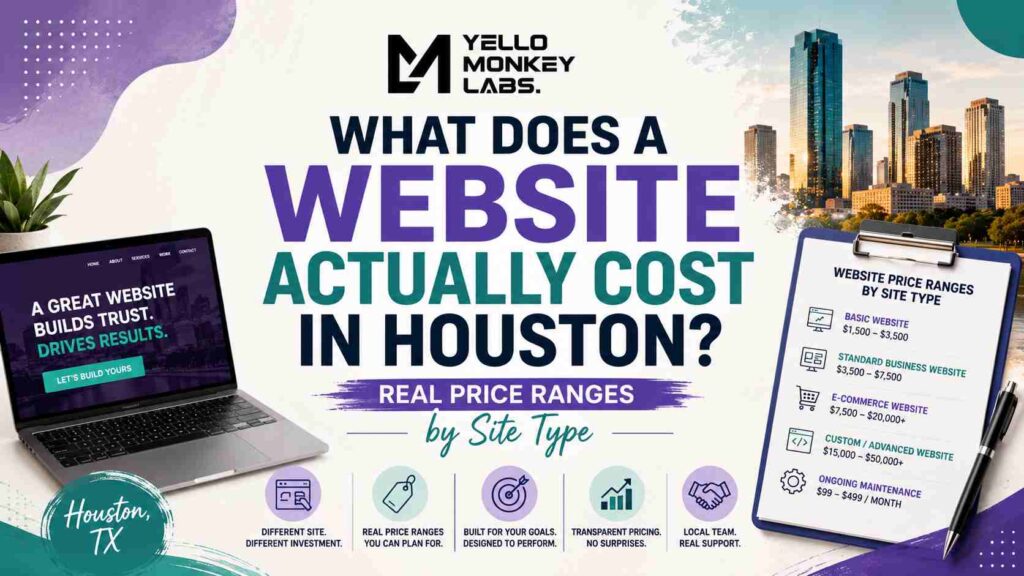
A professional small business website in Houston costs $3,500–$12,000 in 2026. A custom lead-generation site runs $8,000–$25,000, and ecommerce typically starts around $12,000. Template-based sites can be built for $1,500–$3,500 but limit how far you can grow. Budget an additional $100–$500 per month for hosting, security and maintenance.
The wide spread is real, not evasive. “A website” describes anything from a five-page template with your logo dropped in to a custom-built lead engine integrated with your CRM. Below is what actually separates them, and where your money goes.
Quick answer: website cost by type
| Site type | Pages | Price range | Timeline | Best for |
|---|---|---|---|---|
| Template brochure site | 5–8 | $1,500–$3,500 | 2–4 weeks | Validating a new business; a placeholder presence |
| Professional small business site | 8–15 | $3,500–$12,000 | 4–8 weeks | Established local businesses that need to look credible |
| Custom lead-generation site | 15–30 | $8,000–$25,000 | 8–14 weeks | Businesses where the site is the primary sales channel |
| Ecommerce (Shopify / WooCommerce) | 20+ plus catalogue | $12,000–$40,000+ | 10–16 weeks | Retailers and D2C brands |
| Web application / custom platform | Varies | $25,000+ | 12+ weeks | Software products, portals, booking systems |
| Design on subscription | Ongoing | [YML: $X/month] | Rolling | Businesses needing continuous design capacity |
What you’re actually paying for
Most quotes present a single number, which makes it impossible to tell whether you’re comparing like with like. Here’s what sits inside a website budget, roughly in order of cost.
Strategy and information architecture — 5–15% of budget
What pages exist, what each one is for, what someone should do next on each. This is the cheapest part of the project and the one most likely to be skipped, which is why so many sites look fine and convert nothing.
If a quote contains no discovery or planning phase, the site will be built on assumptions.
Design — 25–40% of budget
This is the single biggest cost lever, and it’s almost entirely a template-versus-custom decision. More on that below.
Development and integrations — 25–35% of budget
Building the thing, making it fast, making it work on every screen, and connecting it to whatever else you use — CRM, booking system, payment processor, inventory, email platform. Integrations are the most common source of scope creep. Name every system you need connected, in writing, before you sign.
Content and copywriting — 10–25% of budget
Someone has to write the words. If you’re supplying copy, say so and reduce the quote. If the agency is writing it, that’s real work with real cost, and it’s the difference between a site that ranks and one that doesn’t.
SEO foundations — 5–10% of budget
Site structure, URL structure, page titles, headings, schema markup, speed, mobile performance. Built in, this costs very little. Bolted on later, it often means rebuilding.
This is worth being blunt about: retrofitting SEO onto a finished site is one of the most expensive mistakes in web projects. Fixing a bad URL structure after launch means redirects, lost rankings and rework. Getting it right during the build costs almost nothing.
Template versus custom: the honest trade-off
| Template-based | Custom design | |
|---|---|---|
| Cost | $1,500–$3,500 | $8,000–$25,000+ |
| Timeline | 2–4 weeks | 8–14 weeks |
| Looks like your competitors | Often, yes | No |
| Flexibility as you grow | Limited by the template | Unlimited |
| SEO ceiling | Adequate | Higher |
| Performance | Depends heavily on the template | Controllable |
| Resale / asset value | Low | Higher |
Templates are the right answer more often than agencies admit. If you’re a new business validating an idea, or you need a credible presence in three weeks, a well-chosen template built properly is a sensible purchase. Don’t let anyone talk you into $20,000 before you know whether the business works.
Templates become the wrong answer when you’re competing on design, when your process doesn’t fit the template’s assumptions, when you need custom functionality, or when you’ve outgrown the constraints and every change becomes a workaround. At that point you’re paying to fight the template, and a rebuild is cheaper.
Platform choice and what it does to your budget
WordPress — the default for most Houston small business sites. Enormous flexibility, huge plugin ecosystem, easy to find people who can maintain it. The trade-off is that it needs maintaining: updates, security, and plugin bloat that slows sites down over time. Budget for care.
Shopify — the right answer for most ecommerce under a few thousand SKUs. Platform fees are ongoing but you’re buying out of a large category of technical problems.
Webflow — excellent for design-led marketing sites. Faster to build than custom, cleaner than most WordPress builds, but a smaller pool of people who can work on it.
Custom build — appropriate when your site is a product rather than a brochure. Significantly more expensive to build and to maintain.
Platform choice should follow from what the site needs to do. If an agency recommends the same platform for every client regardless of use case, that’s a signal about their capability, not about the platform.
The costs people forget
| Cost | Typical range | Notes |
|---|---|---|
| Hosting | $10–$100/month | Cheap shared hosting is a common cause of slow sites |
| Domain | $12–$40/year | Make sure it’s registered in your name |
| SSL certificate | $0–$200/year | Usually free now via Let’s Encrypt |
| Premium plugins / themes | $200–$1,000/year | Recurring, not one-off |
| Content migration | $500–$3,000 | Moving existing pages, posts and images |
| Photography | $500–$3,000 | Stock photos are visibly stock photos |
| Copywriting | $100–$400/page | If you’re not supplying it |
| Maintenance & security | $100–$500/month | Updates, backups, monitoring, small changes |
| Ongoing SEO | $1,000–$5,000/month | Separate from the build |
Ask for a total cost of ownership figure for year one, not just the build price. A $6,000 build with $400/month of care is a $10,800 first year.
Why two Houston quotes for “a website” differ by $15,000
This is the question we get most often, and there are usually four reasons, none of which are visible in the quote itself.
- Different page counts. A quote for eight pages and a quote for twenty-five pages are not comparable. Get the page list.
- Different design approaches. One agency is customising a template; the other is designing from scratch. Both are legitimate. They are not the same product.
- Content included or not. Copywriting fifteen pages is weeks of work. If one quote includes it and the other assumes you’ll supply it, that’s several thousand dollars of difference hiding in an assumption.
- Different definitions of “done.” Does the quote include SEO setup, analytics configuration, schema markup, speed optimisation, form integrations, training, and post-launch support? Or does it end when the design goes live?
How to make quotes comparable: ask every agency for a page-by-page list, whether copy is included, what integrations are in scope, what happens in the thirty days after launch, and the total year-one cost including care. The cheap quote frequently turns out to be the expensive one.
When a subscription model makes more sense than a one-off build
If your site needs continuous change — new landing pages, seasonal campaigns, ongoing design work — a monthly design subscription can cost less than a series of small projects, each with its own scoping and setup overhead. It also removes the pattern where a site is built beautifully and then never touched again, which is the most common fate of a small business website.
The trade-off is that you’re paying continuously rather than owning a finished asset. It suits businesses with ongoing needs and doesn’t suit businesses that need one good site and nothing more. More on how design on subscription works.
Signs you need a redesign rather than a rebuild
Not every underperforming site needs replacing. Redesign — keeping the platform and structure, changing the presentation and content — costs a fraction of a rebuild.
Redesign is probably enough if: the site is under about four years old, loads reasonably fast, works on mobile, has a sensible URL structure, and simply looks dated or converts poorly.
A rebuild is likely necessary if: it isn’t mobile-responsive, it fails Core Web Vitals badly, it’s built on an abandoned platform or unsupported plugins, the URL structure is a mess, or the content management is so awkward that nobody updates it.
The honest test: get a technical audit before you commission either. It costs a few hundred to a couple of thousand dollars and it will tell you which conversation you’re actually having. [YML:https://yellomonkey.com/services/search-engine-optimization/ ]
Frequently asked questions
How long does a website take to build in Houston?
Two to four weeks for a template build, four to eight weeks for a professional small business site, eight to fourteen weeks for a custom build, and ten to sixteen weeks for ecommerce. The most common cause of delay is not development — it’s waiting on content and approvals from the client side. Assign one internal decision-maker before you start.
Do I own my website?
You should own the domain, the hosting account, the content, the design files and the site itself. Get it in writing. Some agencies retain ownership or host on proprietary platforms you can’t export from, which turns leaving into a rebuild. Ask directly: “If I leave, what do I keep and how do I take it?”
Should the same company do my website and my SEO?
It helps, because the SEO foundations get built in rather than retrofitted, and there’s nobody to blame if the site doesn’t rank. It isn’t essential. What matters is that whoever builds it knows what the SEO requirements are, and that those requirements are in the brief before development starts.
What’s a fair deposit?
Fifty percent up front and fifty on completion is standard for smaller projects. Larger builds are usually milestone-based — a third on signing, a third at design approval, a third at launch. Paying 100% up front is unusual and worth questioning.
Can I supply my own content to reduce the cost?
Yes, and it can meaningfully lower the quote. But be realistic about whether you’ll actually write it. Client-supplied content is the number one cause of stalled web projects. If it’s likely to sit on your to-do list for two months, pay someone to write it — the delay costs more than the copywriting.
Is a cheap website worth it?
Sometimes. A $2,000 template site built properly by someone competent beats a $12,000 site built badly. What’s rarely worth it is a cheap site with no strategy, no SEO foundations and no maintenance plan, because you’ll pay to replace it inside two years.
Get a fixed-price quote
We’ll give you a page-by-page scope with a fixed price and a delivery date, including what’s in and what’s out — usually within 48 hours of a short conversation.
Get a fixed-price website quote → https://yellomonkey.com/